

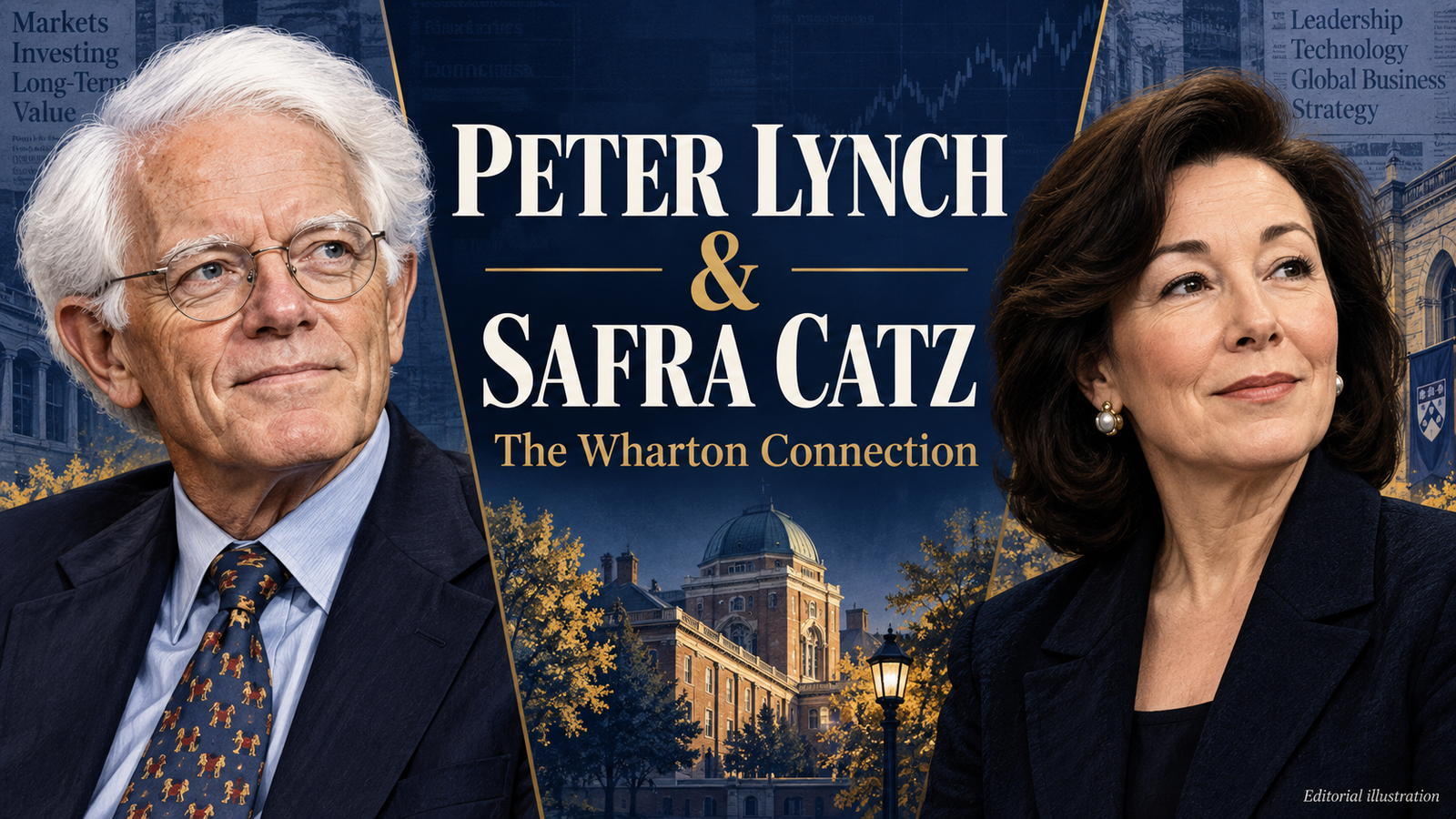
Peter Lynch and Safra Catz share a documented educational connection: both are alumni of the University of Pennsylvania’s Wharton School. Lynch is best known for managing Fidelity’s Magellan Fund, while Catz built her reputation through senior leadership at Oracle.
However, the authoritative public sources reviewed for this article do not establish a family relationship, business partnership, or mentor–student relationship between them. Their shared university background is clear; a direct personal or professional connection remains unverified.
Understanding why these names belong in a business discussion requires separating that educational link from their very different careers. Lynch evaluated companies as an investor. Catz helped lead and reshape a major technology company from within.
The Wharton Connection—and Its Limits
Wharton’s own publications identify Peter Lynch as WG’68, indicating his graduate business class of 1968. The school identifies Safra Catz as W’83, L’86, reflecting her Wharton undergraduate education and subsequent law degree at the University of Pennsylvania.
These records establish that both studied at the same business school, but in different programs and graduating classes. Lynch’s Wharton graduation preceded Catz’s undergraduate graduation by 15 years.
That distinction matters. Being alumni of the same institution does not establish that two people attended classes together, worked together, or knew each other personally.
There is also a publishing connection. Wharton Magazine featured both Lynch and Catz in its anniversary issue, recognizing their respective business achievements. Lynch’s profile focused on his investment career; Catz’s examined her influence as Oracle’s president and chief financial officer at that time.
Their appearance in the same alumni publication provides a concrete reason to discuss them together. It does not prove a relationship beyond their shared institutional background.
| Point of comparison | Peter Lynch | Safra Catz |
|---|---|---|
| Wharton affiliation | Graduate business alumnus, class of 1968 | Undergraduate alumna, class of 1983 |
| Additional Penn education | Not addressed in the sources reviewed | Law degree, class of 1986 |
| Principal career association | Fidelity Investments | Oracle |
| Best-known work | Managing the Magellan Fund | Corporate finance and executive leadership |
| Documented shared connection | Wharton alumni community | Wharton alumni community |
Peter Lynch’s Career: Studying Businesses as an Investor
Peter Lynch managed Fidelity’s Magellan Fund from May 1977 to May 1990. His reputation rests largely on the fund’s performance during those 13 years and his ability to explain investing in language ordinary readers could understand.
Wharton Magazine reports that Magellan averaged approximately 29.2% annually during his tenure. That figure describes a historical fund record, not a return that readers should expect to reproduce.
Lynch became associated with finding investment ideas in recognizable businesses. Wharton’s profile discusses companies such as Taco Bell, Dunkin’ Donuts, and Hanes as examples from his career.
The Hanes example is especially useful. His wife’s enthusiasm for its L’Eggs products helped draw his attention to the business. He then investigated its distribution model and commercial opportunity. Everyday observation supplied an idea; research helped determine whether the idea had substance.
This is a more accurate reading of his approach than assuming that liking a product makes its shares a good investment. Product familiarity can raise a useful question, but it cannot answer every question about a company’s finances, prospects, or share price.
Lynch also reached readers through One Up on Wall Street, Beating the Street, and Learn to Earn. The Museum of American Finance identifies these books as an important part of his contribution to investment education.
His career therefore combines professional portfolio management with a broader effort to make business analysis accessible.
Safra Catz’s Career: Leading a Business From Within
Safra Catz approached business from a different direction. Before joining Oracle, she worked in investment banking at Donaldson, Lufkin & Jenrette. Wharton Magazine describes her work there in the software sector.
She joined Oracle as senior vice president in 1999 and subsequently held positions including president, chief financial officer, and chief executive officer. Her career placed her at the center of financial management, acquisitions, and corporate operations.
Wharton’s historical profile highlights her role in Oracle’s acquisition of PeopleSoft. It also describes her influence on spending discipline and the company’s financial performance.
These responsibilities differ from those of a mutual fund manager. An investor decides whether to own part of a business. A corporate executive helps determine how that business operates, spends money, and pursues growth.
What Is Safra Catz’s Current Oracle Role?
As of October 1, 2026, Oracle identifies Catz as executive vice chair of its board of directors.
Oracle announced the transition on September 22, 2025, when Clay Magouyrk and Mike Sicilia were promoted to chief executive officers. Catz moved from the CEO position to executive vice chair.
Oracle’s 2026 proxy statement confirms that transition and describes her new position as both an executive and board role.
Consequently, older descriptions of Catz as Oracle’s current CEO need updating. She remains associated with Oracle’s leadership, but her title and responsibilities have changed.
Why Their Careers Make an Interesting Comparison
Peter Lynch and Safra Catz can be compared meaningfully without suggesting that they collaborated. Their careers illustrate two different ways of evaluating and influencing business value.
Lynch’s work involved selecting investments across companies. Catz’s executive work involved decisions within Oracle, including financial management and acquisitions.
The following comparison describes the responsibilities of their roles, rather than claiming that they shared a personal philosophy.
| Business question | Fund manager’s perspective | Corporate executive’s perspective |
|---|---|---|
| Is the business attractive? | Assess whether its shares belong in a portfolio | Assess where the company should compete and invest |
| How should money be used? | Allocate fund capital among investments | Allocate company resources among operations and opportunities |
| What does growth mean? | Evaluate its implications for future investment returns | Plan and execute the activities needed to support it |
| How are results assessed? | Examine portfolio performance over time | Examine operating and financial outcomes |
Consider a hypothetical software company with increasing sales but rising costs. An investor might study whether future earnings justify the share price. An executive might examine why costs are rising and whether spending should be reduced or redirected.
Both perspectives involve financial judgment. They operate at different levels and carry different responsibilities.
This distinction makes the comparison useful for business students and general readers. It explains how investment analysis and corporate leadership relate without treating them as interchangeable occupations.
Are They Related, Business Partners, or Mentor and Student?
The sources reviewed do not establish any of these relationships.
Their Wharton affiliations support an educational connection. Their separate career records support a comparison between investment management and technology leadership. Neither finding is evidence of a family tie or joint business venture.
There is also no verified basis in the reviewed material for saying that Lynch mentored Catz or that she adopted her leadership approach from him.
The careful answer is therefore limited: a direct relationship has not been established by the evidence reviewed. This leaves room for information that may exist outside those sources without presenting speculation as fact.
Readers should apply the same distinction to claims about investments. The pairing of their names does not demonstrate that Lynch endorsed Catz, recommended Oracle, or participated in a venture with her.
The documented story is still meaningful. Peter Lynch and Safra Catz belong to the same Wharton alumni community and achieved prominence through different business careers. Lynch’s legacy centers on selecting and explaining investments; Catz’s centers on financial management and corporate leadership. Their shared education offers a valid connection, while their career differences explain what makes the comparison worth understanding.