
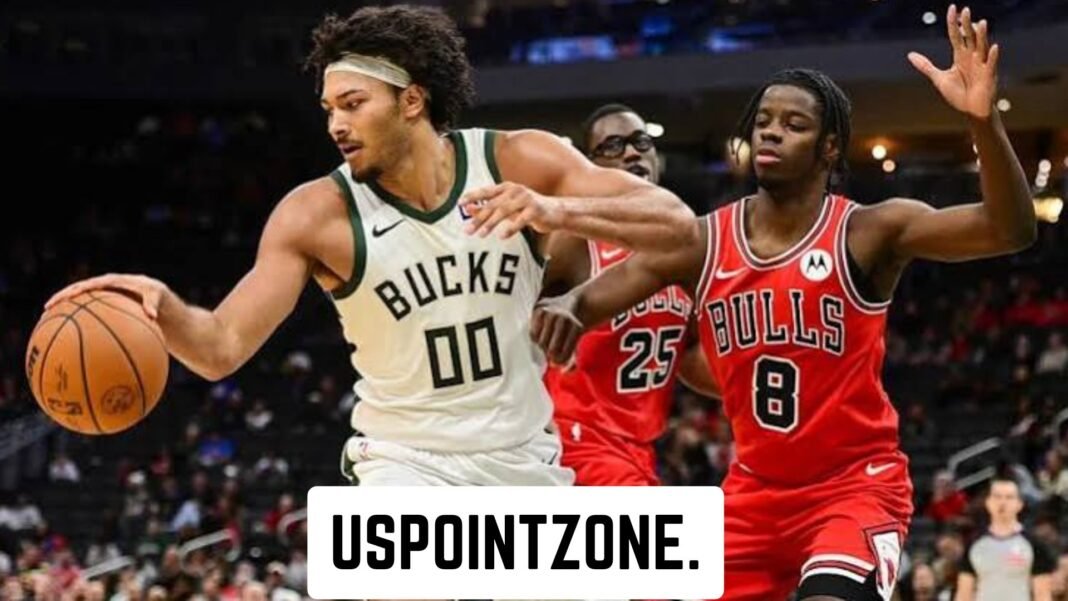
The Milwaukee Bucks vs Chicago Bulls match player stats from October 23, 2026, show Chicago winning 132–125 at Fiserv Forum. Tyler Herro led all scorers with 34 points for Milwaukee, while Norman Powell paced Chicago with 25. Caleb Wilson added 21 points as the Bulls recovered from a 15-point first-quarter deficit.
This article covers that specific regular-season meeting. The standout individual performance belonged to Herro, but Chicago’s balanced scoring and stronger finish decided the result.
Final Score and Quarter-by-Quarter Breakdown
Milwaukee controlled the opening quarter, but Chicago changed the direction of the game before halftime. The Bucks still held narrow leads after the second and third quarters, leaving the outcome open entering the final period.
| Team | First quarter | Second quarter | Third quarter | Fourth quarter | Final |
|---|---|---|---|---|---|
| Chicago Bulls | 17 | 44 | 41 | 30 | 132 |
| Milwaukee Bucks | 32 | 30 | 42 | 21 | 125 |
Sports Illustrated’s game record shows that Chicago won the second quarter by 14 points and the fourth by nine. Those two periods overturned Milwaukee’s commanding start.
The third quarter was especially productive offensively, with the teams combining for 83 points. However, Milwaukee’s scoring dropped to 21 in the fourth, creating the opening Chicago needed.
Milwaukee Bucks Player Stats
Herro supplied Milwaukee’s largest scoring contribution, while Jaime Jaquez Jr. recorded a double-double. Kyle Kuzma also contributed across scoring, rebounding, and passing.
The following figures come from Sports Illustrated’s detailed game box score.
| Milwaukee player | Points | Rebounds | Assists |
|---|---|---|---|
| Tyler Herro | 34 | 5 | 4 |
| Jaime Jaquez Jr. | 19 | 11 | 5 |
| Kyle Kuzma | 14 | 9 | 4 |
| Myles Turner | 12 | 3 | 1 |
| AJ Green | 11 | 1 | 0 |
| Ryan Rollins | 11 | 7 | 6 |
| Kel’el Ware | 11 | 4 | 0 |
| Kasparas Jakučionis | 7 | 2 | 5 |
| Ousmane Dieng | 3 | 1 | 1 |
| Brayden Burries | 3 | 1 | 3 |
Tyler Herro’s scoring kept Milwaukee competitive
Herro made 12 of 24 field-goal attempts, including five of 10 from three-point range. That gave Milwaukee an efficient leading scorer rather than simply a high-volume shooter.
His consecutive fourth-quarter three-pointers also helped the Bucks regain the lead. Nevertheless, Milwaukee could not turn that late surge into a winning finish.
Milwaukee’s supporting contributions
Jaquez combined productive scoring with rebounding and playmaking, although his six turnovers reduced the value of that production. Kuzma finished one rebound short of a double-double and committed no turnovers.
Turner recorded five blocks, providing a significant individual defensive contribution. Blocks alone, however, do not measure every defensive possession or explain the final score.
Chicago Bulls Player Stats
Chicago finished with seven players in double figures. Powell led the scoring, but Wilson, Leonard Miller, and several supporting players gave the Bulls multiple ways to generate points.
| Chicago player | Points | Rebounds | Assists |
|---|---|---|---|
| Norman Powell | 25 | 4 | 1 |
| Caleb Wilson | 21 | 6 | 1 |
| Leonard Miller | 19 | 3 | 2 |
| Jalen Smith | 14 | 13 | 1 |
| Buddy Hield | 13 | 2 | 2 |
| Isaac Okoro | 12 | 3 | 1 |
| Tre Jones | 11 | 3 | 8 |
| Matas Buzelis | 7 | 5 | 3 |
| Josh Giddey | 6 | 4 | 9 |
| Noa Essengue | 4 | 1 | 1 |
Powell found points despite difficult outside shooting
Powell’s 25 points require some context. He shot seven of 20 overall and two of 12 from three-point range, but converted all nine free throws.
His foul shooting helped protect his scoring contribution on a night when his outside attempts frequently missed. It also illustrates why points should be read alongside shooting percentages and free-throw production.
Chicago received useful production beyond its leading scorer
Miller scored 19 points on seven-of-11 shooting without committing a turnover. Hield added 13 points in just over 15 minutes, making five of six shots.
Meanwhile, Giddey and Jones contributed through distribution. Their combined 17 assists show how players can influence an offense without leading the scoring table.
How Chicago Turned the Game Around
The game moved through several distinct stages. Milwaukee established an early advantage, Chicago erased most of it before halftime, and both teams continued scoring heavily in the third quarter.
According to the Field Level Media report carried by Reuters, the Bucks led 19–6 early and finished the first quarter ahead 32–17. Chicago later produced a 16–0 second-quarter run, helping turn a comfortable Milwaukee lead into a close contest.
The Bulls trailed only 62–61 at halftime. By the end of the third quarter, Milwaukee’s advantage stood at 104–102.
Chicago then scored the first six points of the fourth quarter. That opening stretch mattered because it immediately placed pressure on Milwaukee to respond instead of allowing the Bucks to manage a lead.
Herro’s late shooting briefly changed the picture again. However, Chicago answered through Wilson’s free throws and defensive plays that interrupted Milwaukee’s closing possessions.
The important distinction is between making a comeback and completing one. Chicago recovered early enough to remain competitive, then executed the final stretch well enough to secure the win.
Why Free Throws Were So Important
Brew Hoop’s game recap identified a major difference at the foul line: Chicago made 26 of 28 free throws, while Milwaukee converted 14 of 26.
Those totals represent approximately 92.9% for Chicago and 53.8% for Milwaukee. The Bulls gained a 12-point advantage in made free throws despite attempting only two more.
That comparison helps explain how Milwaukee lost despite scoring 125 points. The Bucks generated substantial offense, but missed opportunities at the line made their scoring less dependable.
Still, it would be misleading to subtract missed free throws from the final result and declare a different winner. A changed score can alter defensive decisions, substitutions, shot selection, and intentional fouling.
The reasonable conclusion is narrower: Chicago converted its free-throw opportunities much more effectively. In a seven-point game, that difference deserves considerable attention.
Research Review: What the Numbers Establish
This report compares published box-score records and written game accounts. It does not claim courtside attendance, player interviews, or firsthand access to either team.
One important research finding was that some secondary statistics pages displayed incomplete figures. In one case, the individual scoring totals did not match the stated final score. Those figures were excluded.
The detailed Sports Illustrated box score agrees with the principal scoring totals in the published game reports. It also lists Smith with 13 rebounds and Jaquez with 11, supporting their double-doubles.
The basketball interpretation is that Chicago benefited from several complementary contributions. Scoring, passing, rebounding, and late defensive plays came from different players, reducing the burden on Powell.
Milwaukee’s performance shows a different lesson. Having the game’s leading scorer can keep a team competitive, but it does not compensate automatically for missed free throws or unsuccessful closing possessions.
These are conclusions drawn from the recorded performance. They do not establish how either team will perform in a future meeting.
Frequently Asked Questions
Who won the Bucks vs Bulls game on October 23, 2026?
The Chicago Bulls defeated the Milwaukee Bucks 132–125 at Fiserv Forum in Milwaukee.
Who scored the most points?
Tyler Herro led all players with 34 points. Norman Powell was Chicago’s leading scorer with 25 points.
Which players recorded double-doubles?
Jalen Smith finished with 14 points and 13 rebounds for Chicago. Jaime Jaquez Jr. recorded 19 points and 11 rebounds for Milwaukee.
Who led each team in assists?
Josh Giddey led Chicago with nine assists, while Ryan Rollins led Milwaukee with six. Tre Jones also supplied eight assists for the Bulls.
What was the biggest statistical difference?
Free-throw conversion was a major difference. Chicago made 26 of 28, compared with Milwaukee’s 14 of 26, producing a 12-point advantage at the line.
Conclusion
The October 23 Milwaukee Bucks vs Chicago Bulls match ended with Chicago winning 132–125 despite Herro’s game-high 34 points. The Bulls combined balanced scoring with accurate free throws and a stronger fourth quarter.
The player stats explain both sides of the result: Milwaukee received substantial individual production, while Chicago assembled the more effective finish.
Read more :Dallas Yocum: What the Public Record Reveals About Mike Lindell’s Former Wife